Total Pageviews

Monday, July 5, 2010

Volvo V60 (2011)

The Volvo V60 makes its entry onto the car market with its sights firmly set on giving the all-new S60 sedan model a tough match over the title of "The Most Dynamic Volvo Model Ever".

"Many of the customers who had an advance look at the new V60 during the development process feel that its attitude is at least as sporty as that of the all-new S60," says Volvo Cars Design Director Peter Horbury.

No less than 90 percent of the annual Volvo V60 production of 50,000 cars will find European buyers.

"The typical sports wagon customer is an S60 buyer who would like some extra space and flexibility, but without the slightest compromise on sporty design and exciting driving properties," says Volvo Cars President and CEO Stephen Odell, and adds:

"The competition is razor-sharp and the customers in this segment know exactly what they want. That is why we have further boosted the interior's sense of exclusive quality and packed the car with safety- and comfort-related technical innovations. The result is a truly unique sports wagon, in total harmony with its sporty attitude."

Coupe rather than estate car

The pronounced wedge shape and the slim coupe-like roof line of the new Volvo V60 are accompanied by the shoulder profile along the car's sides, creating a gentle yet powerful double wave from the headlamps at the front to the tail lamps at the rear.

"From the design viewpoint the focus was on making the car as close to a coupe as possible, while retaining that handy extra space at the rear. Our sports wagon does not aim to compete with the traditional estate car. For the customer who wants a lot of load space, there is our V70 or XC70," says Örjan Sterner, head of exterior design for the new Volvo V60. He adds: "The dip in the middle of the double wave visually pushes the car down. This enhances the stance and makes the car look sleeker and lower. The sculpted bonnet and the short overhangs front and rear also emphasise the sports car feel."

Uncompromising chassis approach

Volvo Cars' chassis experts have chiselled out the driving experience in the new Volvo V60 with the same passion and uncompromising approach that characterised the development of the all-new S60 sedan.

The result is an authentic sports wagon with driving properties that do the sporty lines full justice.

"We've pushed the envelope to limits we've never previously approached. You simply have to drive this car to appreciate how we've driven chassis development to its pinnacle. Take the car out on a narrow, winding country road where every bend brings a new challenge and the new V60 will demonstrate its agility with sparkling enthusiasm," says Stefan Sällqvist, who headed the development of the chassis in the new Volvo V60.

Volvo's new sports wagon is available with a choice of two chassis. On the European market the newly developed dynamic chassis is standard, while some other markets will have the touring chassis as standard with the dynamic variant available as an option.

The difference between the two chassis alternatives is to be found in the dampers and the front and rear subframes. Here the touring variant has a somewhat softer setting to give a smooth ride on poorer road surfaces.

Every single detail refined

"The spotlight was on giving the concept of comfort a whole new dimension. The dynamic chassis has an alert, quick-responding character that puts the focus on the driving experience, yet without diluting ride comfort," explains Stefan Sällqvist.

In addition to the two standard chassis, all variants of the Volvo V60 can be specified with the optional FOUR-C (Continuously Controlled Chassis Concept) active chassis, which has been modified and refined for better control and comfort compared with previous Volvos.

The software in the AWD (All Wheel Drive) system has been modified to allow the four-wheel drive variants (AWD is standard in the T6 and optional with D5 with automatic gearbox) of the new Volvo V60 to exploit the sporty new chassis to the limit.

During the development process, the chassis team worked on the new Volvo V60 in parallel with the all-new Volvo S60. The result is a solution that features changes and refinements to virtually every single detail that influences a car's driving properties. This includes improved steering, stiffer springs and bushes as well as more damping than in any previous Volvo.

The first sports wagon with Advanced Stability Control

The dynamic new chassis is backed up by a range of electronic systems that sharpen the sporty driving experience still further.

Like the all-new S60, the new V60 is fitted with Advanced Stability Control. With a new roll angle sensor, it is possible to identify any skidding tendency at a very early stage. This means that the anti-skid system can step in earlier and with greater precision. Advanced Stability Control is a great asset in dynamic driving involving considerable lateral forces, which improves handling and rapid avoiding manoeuvres.

New Corner Traction Control for smoother cornering

Corner Traction Control is a new feature that uses torque vectoring so the car corners even more smoothly. This technology is a further refinement of the Dynamic Stability and Traction Control (DSTC) system.

When cornering, the car's inner driven wheel is braked, causing more power to be transmitted to the outer driven wheel. This allows the driver to corner more tightly while reducing any tendency to understeer.

A highly advanced braking system is an important part of the dynamic driving properties of the new Volvo V60. Volvo's new sports wagon is equipped with a number of features that interact to provide the shortest possible stopping distance in all scenarios.

Exclusive quality - with extra functionality

The interior of the Volvo V60 sports wagon is a clear example of how Volvo Cars' designers have added excitement, contrast and a playful element to the Scandinavian design tradition's rational simplicity and functionality.

"The interior has a decidedly extrovert attitude, but without losing any of its practical Scandinavian roots. The new Volvo V60 brings us up to a whole new level when it comes to the integral experience of colour, form, material and technology," says Volvo Cars' Design Director Peter Horbury.

The interior is thus lavish in terms of its driver-oriented details, but it is still a five-seater car offering comfortable space for all its occupants. Scandinavian design's rationality, simplicity, clarity and functionality are all prominent in the new V60:

* The 40/20/40-split rear seat and the fold-flat front passenger seat make it possible to combine passengers and load in a remarkably flexible way. Each backrest in the three-piece rear seat is folded with exceptional ease to create an entirely flat load floor. The rear seat headrests can be folded electrically.
* The load area has been designed for maximum utilisation of each available millimetre. The 1095 millimetre wide tailgate in combination with extra space behind the wheel housings and under the load floor is an example of the systematic approach adopted to ensure generous load capacity. The load area has a capacity of 430 litres.
* The rear seat can be specified with integrated child booster cushions in the two outer seats.

The most high-tech Volvo ever - with Pedestrian Detection

The sporty interior of the new Volvo V60 is also the most advanced high-tech environment ever available to a Volvo driver.

"The interior of the new Volvo V60 is all about innovative design in two areas: form and technology. The design is characterised by sporty freshness down to the smallest detail. The technological aspect includes all those smart solutions that contribute to a driving experience unlike that of any other Volvo - from collision avoidance safety and comfort systems to infotainment and audio excellence of absolute world class," says Tomas Ahlborg, Project Director for the new Volvo V60.

Pedestrian Detection with full auto brake can detect if a pedestrian steps out into the road in front of the car. If the driver does not respond in time, the car can automatically activate the brakes.

"Volvo has always led the way when it comes to protecting the occupants in our cars. In recent years we have adopted groundbreaking initiatives that help the driver avoid collisions with other vehicles. Now we are taking a giant stride forward with technology that can contribute to increased safety for unprotected road users as well," says Thomas Broberg, Senior Safety Advisor at Volvo Cars.

Can avoid collisions at speeds below 35 km/h

In an emergency situation the driver first receives an audible warning combined with a flashing light in the windscreen's head-up display. In order to prompt an immediate, intuitive reaction this warning resembles a brake light. At the same time, the car's brakes are pre-charged. If the driver does not react to the warning and an accident is imminent, full braking power is automatically applied.

Pedestrian Detection with full auto brake can avoid a collision with a pedestrian at speeds up to 35 km/h if the driver does not react in time. At higher speeds, the focus is on reducing the car's speed as much as possible prior to impact. Speed can be reduced by up to 25 km/h.

Statistics reveal that the car's speed has considerable importance for the outcome of the accident. A lower speed of impact means that the risk of serious injury is significantly reduced.

City Safety standard

The new Volvo V60 also features City Safety as standard.

With City Safety, the car automatically brakes if the driver fails to react in time when the vehicle in front slows down or stops - or if he or she is driving too fast towards a stationary object. The system can lessen or even entirely avoid low-speed rear-end impacts at speeds up to 30 km/h.

More powerful T6 version

During its first year of production, the new Volvo V60 will be available with a variety of diesel and petrol engines spanning the range from an economical 115 horsepower DRIVe version to an eager high-performance turbocharged version producing 304 horsepower. The focused drive to cut CO2 emissions has lowered fuel consumption throughout the engine range.

The T6 petrol engine has a displacement of 3.0 litres and has been improved still further, primarily thanks to lower internal friction. It now pumps out 304 bhp and no less than 440 Nm of torque. Acceleration from 0-100 km/h takes 6.6 seconds and top speed is limited to 250 km/h.

At the same time, Volvo Cars' engine specialists have succeeded in cutting fuel consumption by about 10 percent to 10.2 l/100 km (EU Combined).

The engine's power is delivered to the wheels via Volvo's second-generation six-speed automatic Geartronic transmission. New valves and lower friction mean faster gearchanges than before. AWD (All Wheel Drive) is standard on the T6.

New direct-injected two-litre engine

The new four-cylinder 2.0T GTDi (Gasoline Turbocharged Direct Injection) engine has a displacement of two litres and produces a generous 203 bhp, with 300 Nm of torque available from 1750 rpm. Acceleration from 0-100 km/h takes 7.9 seconds with a manual gearbox and 8.4 seconds with automatic transmission. Top speed is limited to 230 km/h with the manual gearbox and 230 km/h with the automatic.

New in-house-developed turbocharged technology, direct injection and twin variable camshafts produce a unique combination of low fuel consumption, low emissions and a high and broad performance range, all packaged in a very compact format.

Later during the first year of production, the new Volvo V60 will also become available in a 2.0 GTDi variant producing 240 bhp and 320 Nm of torque.

Two new 1.6-litre GTDi engines

In addition there is a new 1.6-litre GTDi engine which is available in two versions: 1.6 GTDi (T3) with 150 horsepower and T4 with 180 horsepower.

The 180 bhp engine offers maximum torque of 240 Nm from just 1500 rpm all the way up to 5000 rpm. During short-term overboost, it provides an impressive 270 Nm of torque. This gives excellent lugging ability throughout the speed range. The torque curve is relatively gentle, resulting in a particularly comfortable driving experience.

The 150 horsepower engine offers 240 Nm of torque.

The 2.0T, T5 and T4 are available in combination with Volvo's automatic six-speed Powershift transmission or a six-speed manual gearbox, while the T3 comes with a manual gearbox.

Two five-cylinder turbodiesels

The engine range also includes two five-cylinder turbodiesels.

The D5 high-performance engine with twin turbos produces 205 horsepower and 420 Nm of torque. Acceleration from 0-100 km/h takes 7.9 seconds (manual and automatic). Top speed is 230 km/h (limited) with the manual gearbox and 230 km/h with the automatic.

In the most recent D5 version, which was introduced in spring 2009, performance and driveability requirements have been met by fitting two turbochargers of different sizes, one taking over from the other and providing added power across a broader rev range.

The complementary properties of the two turbos are utilised optimally for a combination of high performance and low fuel consumption of 5.4 l/100 km (EU Combined) putting this engine in the running for best in class.

In addition there is the newly developed two-litre D3 producing 163 bhp and 400 Nm of torque. Acceleration from 0-100 km/h takes 9.4 seconds (manual and automatic). Top speed is 220 km/h (manual) and 215 km/h (automatic).

The new five-cylinder 2.0D is in principle the same engine as the present 2.4D, but cylinder capacity has been reduced with a shorter stroke to optimise fuel consumption.

Both turbodiesels are available with a six-speed automatic transmission or six-speed manual gearbox.

The D5 with automatic can also be specified with all-wheel drive.

DRIVe diesel

During the course of the first year of production, a DRIVe version of the new Volvo V60 will also be introduced, featuring a 1.6-litre diesel engine. The engine produces 115 bhp and 270 Nm of torque, and will only be available with a six-speed manual gearbox.

Entirely new Infotainment system

The new V60 also gets an all-new Infotainment system where information is presented on a five-inch or seven-inch colour screen in the instrument panel. The screen has a high position to make it easy for the driver to keep his or her eyes on the road.

The audio experience in the new Volvo V60 has been further enhanced compared with previous models.

"Our most advanced system, Premium Sound, has a class-D digital 5x130W amplifier with circuits from Sweden's Anaview, Dolby Digital in combination with Dolby Pro Logic II Surround, the award-winning MultEQ from Audyssey Laboratories and 12 loudspeakers. All this creates an audio experience of absolute world class," says Tomas Ahlborg.

The Volvo V60 is one of the first car models in the world to use the Audyssey Laboratories MultEQ technology. MultEQ eliminates the distortion caused by the car cabin's acoustics, providing crisp, clear sound with improved soundstage for everyone in the car.

In addition to the top-of-the line Premium Sound, which comes with a 7-inch screen, there are another three audio systems.

European target group

The initial annual target for the new Volvo V60 is 50,000 cars. Of these, no less than 90 percent will go to European buyers. The five largest markets are Sweden, the United Kingdom, the Netherlands, Italy and Germany.

The new Volvo V60 is built at the Volvo Cars production plant in Torslanda, Sweden. The first cars will be delivered to customers in autumn 2010.

"The figure '60' in our model range nowadays indicates our sportiest models. The XC60 was the first step. We took the next step with the all-new S60 sedan - and now we're launching the Volvo V60 sports wagon," says Stephen Odell.

Renault DeZir Concept (2010)

Renault has provided a preview glimpse of its new Renault DeZir concept car ahead of the 2010 Paris Motor Show. Renault DeZir stands out as an illustration of the brand's commitment to more emotional styling.

Renault DeZir's sensuous lines and bright red finish express passion. Powered by an electric motor, DeZir is proof that environmental concern and a love for cars are by no means incompatible.

The Renault DeZir project is the first to have been led by Laurens van den Acker and marks the start of a sequence of concept cars that will provide an insight into Renault Design's new vision for the future. It also lays the foundations for the styling cues of Renault's forthcoming vehicles.

The public will get its first opportunity to see Renault DeZir at the 2010 Paris Motor Show.

DEZIR: THE FIRST EVIDENCE OF RENAULT DESIGN'S NEW VISION FOR THE FUTURE

Under the leadership of Laurens van den Acker, Renault's Design Department has taken its inspiration from the brand's new signature 'Drive the Change!' and explores Renault's styling roots to express the company's powerful human dimension via a new strategy founded on the notion of the 'life cycle'. This vision also builds on the bonds that are gradually forged between the brand and its customers at watershed moments of their lives, such as when they fall in love, start to explore the world, found a family, begin to work, take time to play and attain wisdom.

This approach coincides with the introduction of a new Renault design language that takes its inspiration from the three keywords which communicate the brand's vision, namely 'simple', 'sensuous' and 'warm'.

In keeping with this strategy, Renault's concept cars will progressively express this vision, paving the way for a product plan based on a coherent and clear offer.

To implement this, Renault Design has revised its methodology, and a single team of designers will now be responsible for each new concept car and for the ensuing production model it previews.

FALLING IN LOVE

Renault DeZir is the first project to be led by Laurens van den Acker and exemplifies the brand's new philosophy with regard to design. It also marks the implementation of the strategy based on the notion of 'life cycle'. The first step involves falling in love, an experience that is perfectly illustrated by Renault DeZir's powerful, sensuous styling and bright red finish; red being the colour associated with passion.

"Renault DeZir is a statement of our new formal design language which conveys notions such as movement, sensuality and emotion through ideal proportions, in much the same way as an object whose forms have been honed by nature. The result is a warm, stimulating design that says 'Renault'," explains Axel Breun, Renault's Director of Concept Car and Show Car Design. Fluidity was an overriding theme from the initial preliminary sketches, and was expressed by a blend of simple forms and generous volumes. "My early source of inspiration stemmed from the liquid sensation, wave-like movement and contrasts in light associated with certain rippled surfaces," observes Yann Jarsalle, who was in charge of Renault DeZir's exterior styling. "By directly laying out volumes and not just joining together a number of surfaces by lines, I felt more in tune with the world of sculpture than with that of architecture."

The result is a two-seater coupé which is both sculptural in spirit yet perfectly harmonious.

Renault DeZir's shape features prominent wheel arches that accommodate 21-inch wheels, the design of which took its inspiration from the notion of movement.

Meanwhile, the sides feature a combination of flush and recessed forms that play on contrasting light patterns.

Behind the beauty, an electric car

The 'Z' in the name Renault DeZir is a direct reference to Renault's Z.E. signature, and several features of its design are suggestive of two qualities readily associated with electric mobility, namely advanced technology and light weight. Indeed, the recessed, linear styling of the front air intake and the entire rear-end convey an impression of lightness in addition to efficiently channelling battery-cooling air from the front to the rear.

To provide rhythm and balance to the overall package, this smooth, fluid skin contrasts with the ripple effect seen on the aluminium side panels, roof and headlight 'eyelids'. The design of these features alludes to the ripples which can form when a breeze blows over water, while the geometric pattern adds an unmistakable high-tech feel.

The prevailing bright red colour of the body interacts with the graphical forms of the cross-drilled aluminium side panels which equally exude a sense of light weight and technology.

The geometric forms of the glazed areas also contribute to Renault DeZir's easy-to-read overall design and are reminiscent of a fighter-plane cockpit or certain endurance racing prototypes. The absence of a rear window is overcome by the fitment of two rear-facing cameras which provide the driver with a panoramic view of what is happening behind the car.

The creative thinking behind the design of the front end was aimed at recalling Renault's styling heritage, while at the same time paving the way for the design trends of the brand's forthcoming models.

Renault DeZir's front end features a full-width air-intake which strikes out either side of a large, verticallypositioned Renault logo that proudly displays the car's brand pedigree. Meanwhile, the chrome finish of the lozenge contrasts with the dark aspect of the grille to express the statement still further. The air scoops situated at the outer extremities of the front air intake are a legacy of Renault's formal styling language and form an integral part of the air intake's design, as do the headlights which sit above these scoops.

The front-end design previews the new front-end identity that is poised to become a feature of all Renault models in the future.

The headlights take the form of backlit prisms, which make them a highly graphic feature. The perforated 'eyelids' add to this high-tech feel and contribute to Renault DeZir's specific lighting signature. Rear lighting is provided by an illuminated, seemingly floating strip that extends across the full width of the car. The Renault logo is highlighted by backlighting through the fins of the grille and consequently appears to hover in the middle of this space.

The gull-wing doors are another feature that embody automotive passion and reveal a refined interior, while the fact that the left- and right-hand doors open in opposite directions symbolizes a yin and yang-style amorous harmony.

The interior design also suggests lightness. "Love is a sentiment that lifts you; gives you wings," says Stéphane Maïore, who was in charge of Renault DeZir's interior styling. "Inside DeZir, you feel like you're floating on a cloud," adds Stéphanie Petit, Colours and Materials Designer. The forms are soft and light, while the predominant colour is white, although there are also echoes of the same passion red used for the exterior. The materials employed for the interior, like the senses they awaken, are precious, with white leather upholstery and trimming for the seats, dashboard and floor, along with a red lacquered finish for the console and accessories.

The one-piece, two-seater front benchseat provides cocoon-like comfort. To emphasise the sensation of a shared passion and lightness, it comprises a number of interlocking elements trimmed in white leather, with a quilted pattern on the passenger's side, and a contrasting uniform finish on the driver's side, as if to suggest an inexorable attraction between the two. The embroidered pattern on the leather is based on a graphical representation of the Renault logo and is an example of refined of couture a la française. This technique also provides an indication of the coming trend for future production models.

The interior styling takes its inspiration from the idea of an amorous encounter and is based on a coming together of opposites:

* the cockpit-style driver's environment contrasts with the ethereal lightness of the dashboard and the feel of the white leather bench seat,
* the driver's door features a bright red lacquered finish, while the panel of the passenger-side door is trimmed in white leather,
* the dashboard, too, features contrasting finishes, with one part trimmed in white leather and another which exudes a more high-tech feel, with a grained effect that recalls the finish of certain exterior components,
* the white benchseat seems to float on a red-hued bed of light which, once again, symbolises passion. This lighting gently pulses to a rhythm that suggests a beating heart.

But couples also seek to protect one another, and the forms of the interior are suggestive of this notion of protection:

* the centre console seems to present the transmission-mode selection lever to the driver, ensuring that it is within easy reach,
* the housing of the transmission-mode selection lever reveals luminous petals which indicate the selected mode,
* the steering column is shrouded in a red housing that extends up to the steering wheel hub itself.

AN ELECTRIC BEAUTY

Renault DeZir is powered by an electric motor mounted in a mid-rear position to optimize weight distribution over the front and rear wheels. The vertically-mounted 24kW/h lithium-ion battery is located behind the benchseat and provides the car with a range of 160km. Battery cooling is ensured not only by the air channelled from the front to the back of the car, but also - and above all - by the flow of air that enters through the lateral scoops concealed behind the aluminium panels on either side of the body. The basic motor is the same as the unit used for Renault's production electric cars, although an evolution has enabled its power and torque to be uprated to 110kW (150ch) and 226Nm respectively.

Three battery-charging methods can be employed:

* a standard charge using a conventional household plug (fully charges the battery in eight hours).
* a fast charge using a 400V three-phase current (charges the battery to 80 per cent of its capacity in 20 minutes).
* a fast battery exchange thanks to Renault's Quick Drop technology.

In order to optimise range and dynamic performance, Renault Design's technical teams have kept Renault DeZir's weight to a minimum: its body is made from Kevlar, while its tubular steel frame is similar to that employed for Mégane Trophy race car. Renault DeZir's suspension also shares certain features with that of Mégane Trophy - including a double wishbone arrangement - to deliver a particularly high standard of handling precision.

Renault DeZir's aerodynamics have been carefully honed, too, thanks to full underbody fairing and a rear diffuser. The result of this work is a drag coefficient (Cd) of 0.25, as well as outstanding acceleration, with Renault DeZir capable of accelerating from rest to 100kph in five seconds, and from standstill to 50kph in just two seconds.

Renault DeZir's energy efficiency package also includes the recovery of deceleration energy. The technology it employs is based on the same principles as the KERS (Kinetic Energy Recovery System) seen in Formula 1. When the car decelerates, kinetic energy is recovered and stored in the battery. In the case of Renault DeZir, this energy can then be employed by the driver to provide a temporary power boost at the moment he or she chooses, using a button located on the steering wheel.

Driving pleasure is further enhanced by the design of the driver interface. The dashboard visually mirrors the sensations felt at the wheel by means of a graphic display of data received from the accelerometer and speed sensors.

The central touchscreen display incorporates a smart navigation system that synchronises journey information with the driver's diary in order to optimise task management and itineraries. Software incorporated in the dashboard provides drivers with a real-time indication of their energy management ability via a fun interface that uses video-game style graphics.

A DeZir for music

Within the framework of the creation of an audio signature for the brand's upcoming electric vehicles, Renault has been working closely with the highly-regarded IRCAM (Institut de Recherche et Coordination Acoustique/Musique, founded by Pierre Boulez in 1969) to define the sound that best reflects Renault DeZir's personality.

Dimensions

* Length: 4,225 mm
* Width: 1,968 mm
* Height: 1,163 mm
* Height, with doors open: 2,256 mm
* Width, with doors open: 2,682 mm
* Ground clearance: 110 mm
* Wheelbase: 2,582 mm
* Front track: 1,600 mm
* Rear track: 1,705 mm

Technical data

* Motor: Electric synchronous motor with rotor coil
* Power: 110 kW / 150 hp
* Maximum torque: 226 Nm
* Top speed: 180 km/h
* Acceleration 0-100 km/h: 5 seconds
* Acceleration 0-50 km/h: 2 seconds
* Battery: Lithium-ion (24 kW/h)
* Range: 160 km
* Transmission: Rear-wheel drive; Direct, drive, with reducer and forward/reverse inverter
* Drive: Electric with active differential
* Chassis: Tubular steel frame
* Wheels and tyres: 245/35 R 21
* Diameter of ventilated brake discs: 356 mm (front and rear)
* Callipers: 6 pistons (front and rear)
* Cd (drag coefficient): 0.25
* Kerb weight: 830 kg

Sunday, July 4, 2010

sexy2010


PM Abhisit: Moving Thai-Cambodian provisional demarcation won’t affect Thai territory


BANGKOK, July 4 - In an attempt to dispel worries among the public that Thailand might lose some areas along the disputed border with neighbouring Cambodia, Prime Minister Abhisit Vejjajiva said Sunday that the ongoing moving of the provisional demarcation markers would not affect Thailand’s boundary area.

Mr Abhisit confirmed that border demarcation must be made after supervision based on negotiations and the Thai government must submit results of the negotiations for debate in Parliament. So far, Parliament has not approved discussions between the two countries and until now only verifications of the global positioning system (GPS) have been conducted, Mr Abhisit said, noting that none would involve losing Thai territory

Army chief Gen. Anupong Paochinda will conduct additional investigation, he added. It is impossible that the [Thai] military would give away certain territory to another party, he said, noting that a survey must be made to eliminate the dispute.

Clashes between the military of the two countries occurred sporadically along the poorly-defined boundary including the area near the ancient Preah Vihear temple in July 2008. UNESCO endorsed the nearly one thousand year old Preah Vihear temple as a World Heritage site in August 2008 as proposed by the Khmer government.The International Court of Justice awarded it to Cambodia in 1962. (MCOT online news)

Gordon Murray T.25 Concept (2010)

Gordon Murray Design's T.25 City Car will make its first public appearance at the Smith School's World Forum on Enterprise and the Environment in Oxford.

The T.25 represents a major breakthrough in city car design in the areas of weight, footprint, safety, usability and efficiency. Whilst applying a holistic and fit for purpose approach to the design and development of the T.25, Gordon Murray Design have taken the opportunity to incorporate solutions to a multiple of urban mobility problems into the T.25 design.

A world leading 6 metre turning circle will help with urban manoeuvring and parking whilst its 1.3 metre width opens any opportunity for timed lane zones with 2 vehicles travelling and over taking in one lane. Combining this with the car length, could triple lane usage at peak times. The T.25's short length also opens an opportunity to park end on to the curb and the door opening allows 3 cars to be parked in one parallel parking space.

Gordon Murray Design was established in 2007 to develop an innovative and disruptive automotive manufacturing technology trademarked iStream® and the design and prototyping of the T.25 city car was central to both the development and validation of iStream®. This manufacturing process is now industrialised including final factory designs by specialist automotive consultants.

The iStream® assembly process is a complete rethink and redesign of the traditional manufacturing process and could potentially be the biggest revolution in high volume manufacture since the Model T. Development of the process began over 15 years ago and it has already won the prestigious 2008 'Idea of the Year' award from Autocar who were given privileged access in order to make their assessment. The simplified assembly process means that the manufacturing plant can be designed to be 20% of the size of a conventional factory.

This reduces capital investment in the assembly plant by at least 80%. Yet the flexibility of this assembly process means that the same factory could be used to manufacture different variants. The iStream® design process is a complete re-think on high volume materials, as well as the manufacturing process and will lead to a significant reduction in full lifecycle CO2.

* Low capital investment / fast return on investment.
* Lightweight.
* Low energy manufacturing.
* Ultra safe structure.
* Flexible product design.
* Long life chassis.
* Low cost variants.
* Recycled materials.
* Reduced distribution costs and damage.
* Low cost accident repair.
* Flexible body in white tooling.
* Small footprint production plant.
* De-centralised manufacturing and assembly opportunities.
* Quiet and clean plants.
* No paint plant at BIW assembly plant.
* Rapid vehicle assembly.
* Low capital investment in tooling.

The T.25 has recently been seen testing on public roads and has featured in many publications but the Smith School World Forum is the first public appearance and Gordon Murray Design are excited to now be able to release the first images of the car's interior and seating position.

Sir David King, Founding Director of the Smith School of Enterprise and the Environment said: "Our transport sector is hugely dependent on fossil fuels and we need to de-fossilise our economy as quickly as possible. We know most of the technologies already exist in delivering low carbon transportation and the T.25 and iStream® manufacturing processes are clear examples of how the transition can bring new and exciting developments".

Holger Erker, Managing Director of IPE Engineering said: "After a complete and comprehensive comparison of the process details and seeing the vehicle prototype build, our conclusion is affirmative that the innovative vehicle and process design of this project is outstanding. From our analysis the iStream®process can be positively qualified as the most promising manufacturing process development in the car industry of the next decade"

Professor Gordon Murray, CEO & Technical Director of Gordon Murray Design said: "We are very privileged to have been asked to show T.25 publicly for the first time at the World Forum as the aims of our Company are very much aligned with those of the Smith School and therefore this global event"

T.25 USP's and Key Features

* The T.25 represents a major breakthrough in City Car design and is a vehicle that has been optimised through design for strength, performance, weight, cost, safety, usability, tooling, quality, energy efficiency, recyclable and ease of assembly.
* The T.25 external dimensions create the opportunity to:
o park at 90 degrees to the curb, offering real consumer benefits,
o park up to 3 cars in one parallel parking space - giving rise to lower parking charges.
o increase traffic flow,
o explore the possibility of 2 vehicles travelling and overtaking in one conventional lane. Combining this with the car length has the potential to triple lane usage at peak times.
o reduce the environmental impact of vehicle manufacture (ie: lower material content etc) and day-to-day operation.
* The central driving position generates:
o A unique, 'cool' and fun driving experience,
o promotes safety and ease of parking as a result of excellent all-round visibility and road awareness,
o the opportunity to offer a single-seater option with retrofit bolt-in rear seats,
o class-leading rear passenger leg room (better than most 'B-Segment' cars).
* By virtue of the unique door opening system, the T.25 can:
o be parked in very close proximity to other objects and still allow occupants to enter and exit the vehicle. This gives rise to,
o park 2 in one domestic garage,
o allow occupants access from both sides of the vehicle,
o allow easy access to the driver's seat and easy access to the rear child seats.
* The ultra lightweight by design (approximately 550kg) means that:
o component life is increased
o reduced energy is required to power vehicle, giving rise to higher fuel efficiency (mpg/electric battery range).
o a competitive power to weight ratio is achieved
* A world-leading 6 metre turning circle will enhance urban manoeuvring and parking.
* Body panels in the lower periphery of the car are all mechanically affixed and have split lines which are sympathetic to accident damage replacement, leading to rapid assembly times and low cost accident repair.
* First car in class to feature lightweight, low cost independent rear suspension.
* Wing mirrors are within the overall width of the body, thereby minimising accidental damage and subsequent mirror replacement.
* Design for purpose means that the vehicle has excellent pedestrian impact qualities.
* The inclusion of Formula 1 derived materials philosophy and technology coupled with chassis frame design ('Direct Load Path') gives an immensely strong structure ('safety cell') both in 'end' and 'side' impact scenarios. This is also designed to meet the cost targets of high volume production.
* Flat under-floor improves aerodynamic efficiency.
* Class-leading vehicle dynamics
* High level turn indicators for good visibility.
* Positioning of the fuel filler permits refueling from either side of the vehicle.
* Centralised driving instrumentation and controls are designed to maximize drive control.
* Six internal layout options with rear seat adjustment (adjustable within 20 seconds) sets new standards in small vehicle packaging - a long way in front of the Smart For 2 and the Toyota iQ.
* Occupant capacity of between 1 and 3 persons. Luggage capacity of between 160 litres and 720 litres.
* The T.25 has the potential to be first to market for a new "World Car Class" for efficient vehicles, demonstrating new levels of efficiency and low emissions - creating excellent publicity and marketing opportunities.

Bugatti Veyron Super Sport (2011)

On a beautiful sunny day at 25 degrees the Bugatti Veyron Super Sport achieved a new landspeed world record for production cars, on the proving grounds of the Volkswagen Group at Ehra-Lessien (nearby its headquarters at Wolfsburg). In the presence of the German Technical Inspection Agency (TÜV) and a representative of Guinness Book of Records the Bugatti Veyron Super Sport achieved an average top speed of 431 km/h.

Saturday, 2 pm - Bugatti's Pilote Officiel Pierre Henri Raphanel puts his helmet and gloves on, pulls the safety belts tight whilst the engineers check the car a very last time: tyre pressure, temperature, all systems go. Then the orange black Bugatti Veyron Super Sport crosses the light barrier, from now on the time will be taken, within one hour the car has to drive from South to North and then in the opposite direction. No one but the driver is allowed to touch the car during this time. The tension rises. A few minutes later we can hear from the left side the sound of a starting jumbo jet coming closer towards us. First we perceive the headlights of the Veyron, then we can recognize the shape of the car, a loud wooosh…. and Raphanel dashes in top speed past us. The GPS-tachometer stops at 427, 933 km/h. Now the same procedure from the opposite direction. This time the car reaches 434, 211 km/h. As average top speed the representatives of the "TÜV"and Guinness generate a value of 431, 072 km/h (268 mph). This even hit Bugatti's engineering team by surprise.


"We took it that we would reach an average value of 425 km/h," explains Bugatti's chief engineer Dr. Wolfgang Schreiber, "but the conditions today were perfect and allowed even more."

The climax of the Veyron series: the Bugatti Veyron Super Sport

Had a model been especially popular or highly successful in races, Ettore Bugatti's customers often pushed the master to tease out of the engine a few horsepower more for their future car. Bugatti Automobiles S.A.S. had been in a similar situation when their existing customers asked the company to not only design their second model optically differently but to also create a version with a sportier and more extreme driving experience. The result is a car with a uniquely high performance of 1,200-hp (882 kW) offering experienced drivers a whole new dimension of excitement, with a maximum torque of 1,500 Newton metres and a limited top speed of 415 km/h (to protect the tyres) but, the technique of the Bugatti Veyron Super Sport is identical to the record car. The first five Bugatti Veyron Super Sports to come off the production line will constitute a special series of their own, with the same configuration as the landspeed record car.

The Bugatti Veyron Super Sport is a consequent of the further development of the classic exclusive 1,001-hp Bugatti Veyron 16.4, launched in 2005. This model offers a stunning set of specifications, such as the twin clutch gearbox with seven speeds, the extraordinarily precise driving performance in bends and excellent stability when braking and accelerating.

Continuous work in extreme performance ranges lead to constantly new conclusions, which enabled the engineers at Bugatti to develop the Veyron into a direction in which the driver can reach new dimensions. Every modification is designed to produce an even more powerful car for an agile ride. Four enlarged turbochargers and bigger intercoolers have been used to boost the power of the 16-cylinder engine, and the chassis has been extensively redesigned to maintain safety at extreme speed - thanks to slightly raised main-spring travel, stronger stabilisers, and new shock absorbers with a complex architecture originally developed for racing cars. This gives noticeably more precise control of the wheels and the car as a whole. With lateral acceleration of up to 1.4 G and improved interaction between the tyres and the intelligent all-wheel drive system, the Bugatti Veyron Super Sport offers perfect handling and even more powerful acceleration of 1,500 Newton metres on corner exits.

The body has been fine-tuned to improve aerodynamic efficiency and maintain perfect balance in every situation, while the new fibre structure of the all-carbon monocoque ensures maximum torsion rigidity and passive safety - at reduced weight. The skin is made entirely of carbon-fibre composites, and the new Bugatti Veyron Super Sport is available in 100 per-cent clearlacquered exposed carbon on request.

Dynamic exterior

Every detail of this car, and not just its use of advanced motorsport technology, harks back to the pioneering spirit of company founder Ettore Bugatti. This brilliant designer came from a family of artists, and his philosophy was always to combine mechanical perfection and exterior beauty. This ethos remains alive and well at the company, and the Bugatti Veyron Super Sport is wholly unmistakeable, with every external modification serving to coax greater performance from the car.

The Bugatti Veyron Super Sport's flat, elongated silhouette is immediately recognisable. The 16-cylinder engine gets its air from two NACA ducts integrated into the roof, rather than from scoops above the engine. The front air intakes have been expanded and reshaped, with the lower one extending elegantly around the sides to the wheel arch. The revised back looks sportier due to the double diffuser and a centrally arranged exhaust system.

Bugatti has a tradition of making super-sport versions of successful models, usually with racing chassis and supercharged engines. These cars were considered as true racing machines for diehard Bugatti devotees. The most successful were the type 55 and type 57S; only around forty of each were built.

Bugatti Automobiles S.A.S. has sold 260 Veyrons and 35 Grand Sports by now, of which 249 Veyrons and 22 Grand Sports had been delivered. The Bugatti Veyron Super Sport will begin production in the autumn of 2010 at Molsheim along with the Veyron and the Grand Sport. The first five cars - known as the World Record Edition - are in a special black exposed carbon and orange finish and have already been sold.

The Bugatti Veyron 16.4 Super Sport will appear for the first time in public in California at the Pebble Beach Concours weekend in mid-August and will be featured at The Quail, Monterey Historic Races at Laguna Seca and on the concept lawn of the Pebble Beach Concours d'Elegance.

Jaguar XKR 75 (2010)


An exclusive Jaguar XKR 75 makes its debut at the 2010 Goodwood Festival of Speed. Jaguar Land Rover CEO, Dr Ralf Speth, initiated the challenge to the Jaguar engineering team to construct an XKR to celebrate Jaguar's 75th anniversary, which would deliver a combination of enhanced performance, superb chassis and steering control and grip levels to inspire the driving enthusiast to explore the true potential of the XKR's capabilities.

Mike O'Driscoll, managing director, Jaguar Cars, said "The Jaguar XKR 75 will provide owners with exclusivity, excitement and a hint of Jaguar's great heritage. This is a fitting way to celebrate the sporting credentials of the XK marque in the 75th year of the Jaguar name", he continued.

Jaguar engineers increased the power and torque of the acclaimed 5.0-litre supercharged engine to 530PS and 655Nm respectively for the Jaguar XKR 75, to deliver truly outstanding performance. While the limited edition model's top speed is electronically limited to 174mph (280km/h), the Jaguar XKR 75's 0-60mph (100km/h) acceleration time is reduced from 4.6 to 4.4 seconds compared to the standard 510 PS XKR.

Using the rigid lightweight aluminium architecture of the XK as a solid foundation, the increased power of the Jaguar XKR 75 is matched by an agile, dynamic chassis that handles supremely, rides exceptionally well and stops with surefooted reassurance time after time.


The Jaguar XKR 75 features revised suspension and handling for increased precision and agility in addition to the performance enhancements. To ensure the Jaguar XKR 75 remains stable at high speeds, a revised aerodynamic body pack with a front splitter, side sills extensions, a rear diffuser and larger rear spoiler provide increased balance and a reduction in lift. The XKR's computerised Active Differential Control also adjusts to reduce steering sensitivity at very high speeds, further improving stability and driver control.

And with an improved acoustics package for the semi-active sports exhaust, the Jaguar XKR 75 produces a pulse-racing growl to match its performance.

The car's driver-focussed character, however, has not been achieved at the expense of the Jaguar traditional values of refinement and comfort.

"We conceived the XR 75 as a sports car with a duality of character that makes it perfectly suited to driving across Europe to the Nurburgring, completing some very fast laps, and then driving home again, added Mike Cross, Chief Engineer Vehicle Integrity.

The Jaguar XKR 75 features a new Stratus Grey finish. Red brake callipers contrast the eye-catching 20-inch gloss Vortex forged lightweight alloys with a dark technical finish and diamond turn. Customers will have the option to apply a unique body graphic that runs from the front bumper to the rear haunches.

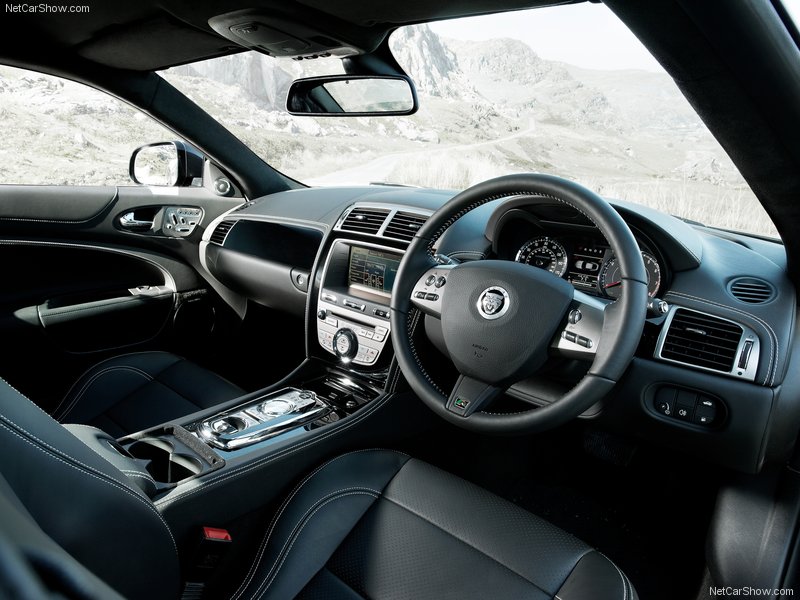
The Jaguar XKR 75's interior completes the driver-focussed performance environment finished in Charcoal with ivory stitch, piano black finish to facia and centre console and a Jet suedecloth headlining.


THE JAGUAR XKR 75 AT A GLANCE

The unique features of the exclusive new XKR 75 include:

•Increased performance through detailed engine and transmission recalibration
◦Power increased to 530PS (compared to 510 PS on XKR)
◦Torque increased to 655Nm (compared to 625Nm on XKR)
◦Upgraded torque converter to handle the increased torque
•Upgraded suspension systems for increased precision and agility
◦Increased spring and damper rates (front springs 28 per cent stiffer, rear springs 32 per cent stiffer)
◦New fully-machined aluminium front and revised rear suspension upright for increased camber stiffness (increased by 25 per cent)
◦Re-tuned Adaptive Dynamics damper control software
◦Reduced ride height (15mm front and 10mm rear)
•Aerodynamic body pack with body coloured finish to front splitter, side sills extensions and rear diffuser, and body coloured larger rear spoiler and rear trunk lid finisher
•Sports exhaust with improved performance and acoustics - system has new crossover pipe and larger exhaust outlets
•New Stratus Grey exterior paint with optional graphics pack
•Red brake callipers surround 20" Vortex forged lightweight alloy wheels, diamond turned with dark grey finish
•XKR performance interior in Charcoal and Ivory stitch leather, with Jet suedecloth headlining and XKR 75 tread plate
•Active front lighting
•Final calibration was done in partnership with the RSR engineering team which has been collaborating with Jaguar on the 2010 motorsport programme.
Production of the Jaguar XKR 75 is limited to just 75 vehicles, which will be available to order from July 2010 in the UK priced from £85,500 OTR. Customer deliveries will commence during October 2010.